Theme Layout

Boxed or Wide or Framed

Theme Translation

Display Featured Slider

No

Featured Slider Styles

Display Grid Slider

Grid Slider Styles

Display Trending Posts

Display Author Bio

Display Instagram Footer

Search This Blog

Powered by Blogger.

Pages

About Me

My photo
I am a first grade teacher who has rediscovered a love for firsties this year. I have taught pre-k, kindergarten, first grade and even second over the past 16 years. I have been married for 17 years to my wonderful husband and have been blessed with 2 very active boys.

Pre-K Back to School

Pre-K Back to School

Pre-K/Kindergarten Literacy

Pre-K/Kindergarten Literacy

Pre-K/Kindergarten Literacy

Pre-K/Kindergarten Literacy

Phonics Games

Phonics Games
Phonics Games
Image Map
   
Blog Design by:
.
Graphics by: MareeTrueLove.
Widget by:Gabby Barba

Calendar Math for Primary Grades

Calendar Math for Primary Grades
Primary Calendar for the Year

Showing posts with label art. Show all posts
Somewhere in the Middle

Somewhere in the Middle


The pendulum swings in the education every twenty years or so they say.  They, the POLICY MAKERS, tell us, the EDUCATORS, what is the best thing for our students and we comply. Yes, sometimes dragging our heels, spitting nails, or just complain to our colleagues about the changes.


I don't always love change, but I understand it is necessary. I am more than happy to listen and try something new IF I believe it will benefit my students.  However,  I won't throw out what I know works!  Just like the old saying goes, "Don't throw the baby out with the bath water!" I believe you need to balance the two extremes for optimal results with your students.

LET'S TAKE A LOOK...


Teachers have debated teaching "letter of the week" for years! One side argues that it is ineffective to teach letters this way as children learn letters that are meaningful to them such as the letters in their names and they won't retain letters taught in a week by week basis.  The other side of the pendulum believes in this systematic approach as they are sure to cover all the letters through thematic teaching incorporating the letter through the majority of activities during the week. 

Truth be told, I am somewhere in the middle! I introduce a new letter each week based on the scope and sequence that my county puts out for our Voluntary Pre-Kindergarten program.  I introduce the letter and the sound through Interactive Alphabet Activities. We practice writing it and we even make an alphabet flip book that my pre-kinders read and then take home to practice.  However, every book we read does not begin with that particular letter and I do not make a craft to go along with each letter. Does this make sense?


Teachers are so passionate about this topic.  Process art gives children the freedom to create and express themselves through a variety or art mediums.  The materials are available as children use their imaginations to design their art. Product art consists of teacher led projects where children follow a set of directions or patterns to make a similar product.  

So I am here to ask, what is wrong with a little of both? I give children ample opportunities at the art center daily to create.  Some days it is process driven projects where children need to cut and glue pieces to make a something in particular like a snowman and other days I put out a variety of materials and my pre-kinders are free to create what ever their little hearts desire! Just as children have different learning styles, some children love the process where they can express their creativity while others want direction and want it to look like a particular object when completed.  Its a win-win as children are able to practice lots of fine motor activities such as cutting, tearing, drawing and gluing all while engaging in the art process.


I have been reading the book, Play: The Foundation that Supports the House of Higher Learning by Lisa Murphy and agree with a LOT of what Lisa  has to say. I agree that children in preschool, pre-kindergarten and even kindergarten need ample time to play as they build social skills, language and have time to manipulate their environment.  That being said, I am intentional about the skills and standards I need to teach.  The blending of play and skills needs to be done with hands on, engaging manipulatives, games and activities to create optimal engagement with these little people! In my classroom, we accomplish this through small group activities as well as during center time.  


There are many different ways to structure our programs, but we as the educators need to know what the current research says, meet the children where they are and then incorporate the social and academic skills that will prepare these children for life as well as school! So please, won't you meet me Somewhere in the Middle?
post signature
Read more »
Mrs. Wathen
0 Comments
Peek into Pre-K  {December}

Peek into Pre-K {December}


As with all kiddos right now, my pre-kinders are over the top with excitement!
Christmas is right around the corner:)
So we have tried to embrace the craziness and roll with it this month!!

Circle time is where we start our day and come back to through out our day for stories, songs, games and other fun activities.  As one of our pre-k standards, we are working on counting words in a sentence.  Drawing boxes around the words gives students a visual to understand that letters make words and words make sentences.  My little helper of the day gets to lead our morning calendar time.  I love watching their confidence grow during this time.  Our poems and songs build rhythm and rhyme as we work on phonological awareness.  


They are a super collection of original poems and favorite nursery rhymes.
Small group is the time we introduce new concepts, provide practice for prior skills taught and work together in fun, meaningful ways.  We have five rotations consisting of Listening/Library Center, Math, Literacy, Computer and the Independent Learning Table.  The Math and Literacy tables are teacher and para led while the Independent Learning table is usually manipulative based and builds on out literacy and math concepts. Class books, glitter number rubbings, games and poetry notebooks are favorites again and again. 


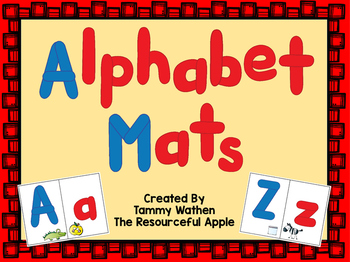
Alphabet Mats cane be found here  Alphabet Mats are perfect for play dough, 
small manipulatives for fine motor engagement  and letter formation.

Center time provides students the opportunity to choose what they want to do and where they want to go.  It includes the dramatic play area, blocks, the alphabet center, the math center, the science center, the sensory table, the puppet theater, computers and the art center.  Children start this time by verbalizing where they want to start playing.  For example, "I want to go to blocks today." This helps develop language with my students and helps them develop a plan for where to start.  


Thanks for stopping by for a Peek Into Pre-k {December}.
Feel free to follow me on Facebook for daily updates and peeks into our day.


You can pin this image for easy reference and follow me on Pinterest.


Happy December Friends!

post signature
Read more »
Mrs. Wathen
0 Comments
 Play Based Learning with Centers

Play Based Learning with Centers


Center time is every preschoolers favorite time of the day.  I am going to share with you a peek into my classroom center time.  We try to incorporate a lot of open ended centers for my pre-kinders to engage in along with a sprinkling of games. Students learn to take turns, share, build vocabulary as well as practice skills taught during small groups in an open ended way!
 

The alphabet center consists of all things language.  We play games like Roll and Cover, write on the magic boards and use LOTS of alphabet manipulatives!  Some days there is an adult stationed there to help facilitate a game and other days the children work and play independently with alphabet materials and writing instruments.  

Roll and Cover


Magic Boards and Picture Name Tags


Alphabet Matches

In the Sensory Tub, there are a variety of materials throughout the year.  Our rule of thumb is to change it out every two weeks and it can revolve around our theme at times.  There is often fine motor and science activities incorporated into this center.  


Pom Poms and Tweezers


Water Table  


Water Marbles from Lakeshore

The Art Center has a balanced approach of process and product driven activities.  We try to offer both types of projects and some projects have a combination of the two.  Watercolor paints, mosaic art, and collage projects are a few of our process driven activities.  The children are able to be creative as they like.  Some projects are product driven like the patterning plates that will be the frame for our Turkey Handprints.  Some students thrive with explicit directions and others with the freedom to create.  


Feather Painting


Felt Pattern Frame

The Math Center offers a variety of maniplatives that are often open ended and games that might need some teacher direction.  Some days students ask us to leave the materials out from our Small Groups (read more HERE) to explore further.  I do have a plan for what materials will be set out each day, but the students often take the lead and embrace our choice or change it quickly.


Snap Cubes


Linking People


Turkey Clothes Pins

The Block Area is limited to four students as it makes sense for the amount of blocks available.  There are several types of blocks such as Legos, colored blocks and Bristle Blocks in addition to the large wooden blocks so more than one type of block is allowed out if there is enough space on the large carpet.  Manipulatives such as cars and animals are often added after building structures and roads.


Making connections from our math lesson


Princesses and Super Heros added during October


Colored blocks and animals


Dramatic Play is a favorite with my boys and girls.  We change it out every two weeks onto something other than home living area and then return to the home living center for two weeks.  The key of any area is to label it and model activities as you visit this area during transitions to new areas. Many of my ELL (English Language Learners) students look for this direction as they build their vocabulary as well as all students as some of the areas are new experiences for all of them.


Home Living Center


The Vet  


The Pumpkin Patch

I will be doing a follow up post on the ins and outs of center time 
and I would love to hear your thoughts.
Please comment below with any questions you have about center time!


Feel free to pin this post and follow me on Pinterest.

The following are affiliate links for your convenience if you are looking 
for products shown in this blog post.


post signature
Read more »
Mrs. Wathen
1 Comments
Incorporating Fine Motor Activities

Incorporating Fine Motor Activities


So many preschoolers and kindergarten friends come to school 
with little fine motor practice.  
The first thought when fine motor comes up is pencil, paper activities, 
but the reality is there are so many ways to build fine motor BEFORE
children are ready for pencil, paper activities.


Clothes pins and larger tweezers offer children practice with the pincer grasp.  
We practice using pop poms and small objects 
as they are grabbed and moved from one place to another.  
Alphabet Mats and sensory tables provide a place for integration with these skills.


Alphabet Mats


Art activities provide fine motor experiences such as paper tearing, 
painting and gluing. While painting, we remind our friends 
to use their "pinching" fingers as they hold the brush. 
 Twirling the paint brush is a circular motion 
also takes practice at the beginning of the year.


Paper tearing also provides additional experiences 
and the scraps are saved for the art center.


Fine motor experience can also be incorporated while teaching math concepts.  
We use pony beads for counting and patterning.  


Play dough is always a go to with counting and tens frames.  
Rolling the dough in itself takes a LOT of practice!


One to one correspondence can be modeled and practiced 
using pom poms and recycled marker caps.
The end of the school year is the perfect time to collect 
old marker caps from students and teachers alike!


There so so many commercial games and materials for sale 
that lend themselves to fine motor practice
like Gumball Grab and Magic Boards.


Scissor practice is another fine motor skill that takes a great deal of practice.
We cut paper and play dough as they offer different resistances.  


Last week I added straws and scissors to our sensory table 
for additional fine motor practice.
We were then going to add string for threading once the straws were all cut.

BUT..

This was found under the table at the end of  day one.
No one claimed it, no parent complained.
LESSON LEARNED!
Scissors will be at the art table with supervision!


Affiliate links are included for your convenience.


Feel free to pin the image below onto your Pinterest boards for easy reference. 
For more fine motor inspiration, follow my Fine Motor Pinterest Board.


post signature
Read more »
Mrs. Wathen
0 Comments

Follow @georgialoustudios